
With food costs on the rise, the dreaded “Mom, what’s for dinner?” question is sometimes a difficult one to answer. We’ve all been there, struggling to decide what to feed our families and ourselves after a tough day at work. This question becomes even harder to answer when your food budget is tight. It feels so much easier and less costly to run out and grab fast food or to toss a frozen pizza into the oven. You’re not alone! Across America there are millions of moms in the same situation. In fact, over 9.5 million families rely on SNAP, or the Supplemental Nutrition Assistance Program, to help put food on the table.1 But the truth is, eating right on a budget does not need to be more challenging or cost more than driving through the nearest drive-thru.
The reality: Poor diet quality is the leading risk factor related to death and disability in the United States- no one is exempt.
The typical American diet is too high in calories, saturated fat, salt, and added sugars and does not include enough fruits and vegetables.2 This diet is a major contributor to many of the leading causes of death in the United States and chronic disease risk including:
- Heart disease;
- Diabetes;
- Stroke;
- High blood pressure;
- Obesity;
- Cancers3
Well over half a million deaths each year in the United States can be attributed to nutrition and obesity related diseases as a result of an unhealthy diet.4 Over the most recent decade, obesity rates in America have continued to rise steadily among adults and youth.5 Sadly, these numbers will continue to grow if immediate action is not taken. There is good news! The first step can begin with you- in your home, on your kitchen table, and in your fridge!
Eating more fruits and veggies can help you live healthier.

Eating the recommended amount of fruits and veggies on a daily basis provides protection against many chronic diseases that are both severe and costly.2 Eating an overall healthy diet that includes a variety of fruits and vegetables helps to combat illness and disease and helps the body to function properly by providing important vitamins and minerals.
We need more fruits and veggies.
Despite the known benefits of eating a diet rich in fruits and veggies, Americans still are not eating anywhere near enough! It is recommended that adults consume 1.5-2 cups of fruits and 2-3 cups of vegetables each day.2 Sadly, fewer than 1 in 10 American adults eat the daily recommended amount of fruits and veggies and this amount is even less for American youth.6

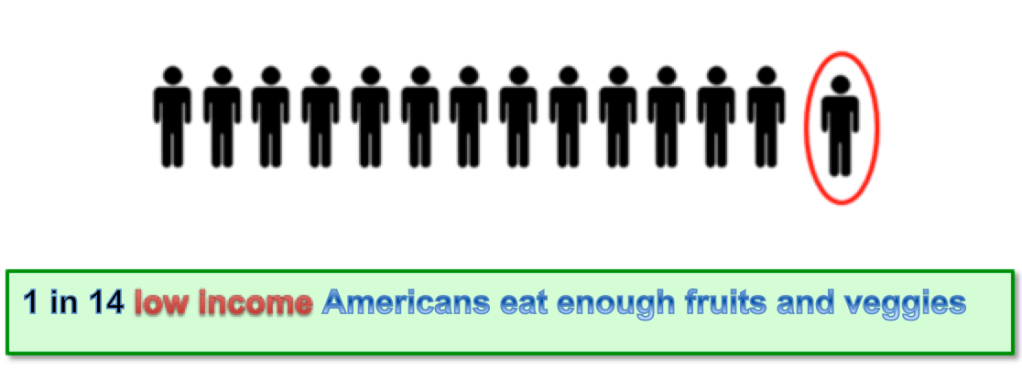
For lower income individuals and families, fruit and vegetable consumption declines even further to about 1 in 14 adults. 6 There is no question- we ALL could benefit from eating more fruits and veggies!
Moms, you can take charge! Food Cents is here to help!
In America, women make most of the food related decisions for their families. Food Cents aims to encourage and empower moms like you, who are working within a limited food budget, to make healthy food choices for you and your family, with the primary goal of increasing fruit and vegetable consumption. Food Cents will provide tips for planning, budgeting, and creating countless meals and snacks that are cost efficient and delicious. By tapping into the power of produce, Food Cents will make the healthy choice the easiest choice.
References
- Understanding SNAP, the Supplemental Nutrition Assistance Program. Feeding America. https://www.feedingamerica.org/take-action/advocate/federal-hunger-relief-programs/snap. Updated January 2020. Accessed January 19, 2020.
- U.S. Department of Health and Human Services and U.S. Department of Agriculture. 2015 – 2020 Dietary Guidelines for Americans. 8th Edition. https://health.gov/dietaryguidelines/2015/guidelines/. Published December 2015. Accessed January 19, 2020.
- Murphy SL, Xu JQ, Kochanek KD, Arias E. Mortality in the United States, 2017. NCHS Data Brief, no 328. Hyattsville, MD: National Center for Health Statistics; 2018.
- The US Burden of Disease Collaborators. The state of US health, 1990-2016: burden of diseases, injuries, and risk factors among US states. JAMA. 2018;319(14):1444–1472. doi:10.1001/jama.2018.0158.
- Hales CM, Fryar CD, Carroll MD, Freedman DS, Ogden CL. Trends in obesity and severe obesity prevalence in US youth and adults by sex and age, 2007-2008 to 2015-2016. JAMA. 2018;319(16):1723–1725. doi:10.1001/jama.2018.3060.
- Centers for Disease Control and Prevention. 2018 State Indicator Report on Fruits and Vegetables. Atlanta, GA: Centers for Disease Control and Prevention, U.S. Department of Health and Human Services; 2018:4.
- Tobey LN, Koenig HF, Brown NA, Manore MM. Reaching low-income mothers to improve family fruit and vegetable intake: Food Hero social marketing campaign-research steps, development and testing. Nutrients. 2016;8(9):562. doi:10.3390/nu8090562.
 Food Cents