
Fruits and vegetables form the foundation of a healthy, balanced diet. Fruits and veggies provide nutrients that are important for health and the maintenance of a healthy body so you can do the things you love!
Most of us are already well aware of the benefits of eating more fruits and vegetables. Food Cents aims to help you and your family eat more fruits and vegetables by helping you to overcome the barriers that are preventing you from doing so.
Sometimes trying to make a big change, relating to any aspect of our lives, can seem daunting. Let’s face it: Change is tough. But having a plan and an understanding of how behavior change works can help you to feel less overwhelmed. The goal is to help you to make small behavior changes that will eventually add up to big change!
Health professionals often help us to understand change by explaining it using various change theories. An important change theory when it comes to health behavior change is the Social Cognitive Theory, or the SCT for short.1 This theory explains that there is an interaction between personal factors in our lives, our behavior, and the environment. 1 It states that a change in any one of these factors can influence the other factors. 1 The example below helps to explain how the SCT might work in real life. 1
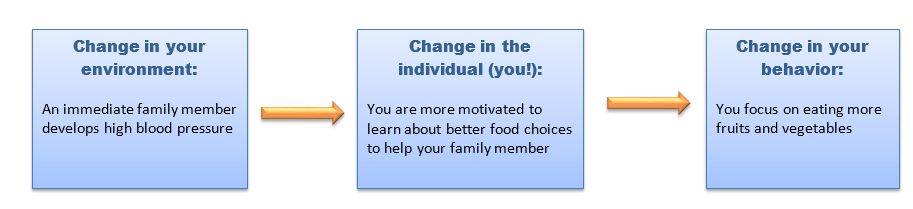
The SCT recognizes that unless you believe in your ability to change a particular behavior, in this case, eating more fruits and vegetables, you will be less able to make the change.2 So believe in yourself and your abilities! Breaking the larger goal into smaller, more manageable goals will help!

So where do we start?
Let’s start right here, with a smaller, manageable goal: Decreasing the amount of fast food we eat. Research shows that American families eat far too much fast food.3 Eating too much fast food can displace healthier foods in our diets such as fruits and veggies. Let’s take a look at why we eat fast food:

These are all great reasons for eating fast food, but do you know what the even greater thing is? Eating healthier, home cooked meals can be just as convenient, cheap, delicious, and kid-approved! The key is to make the healthy choice, the easy choice. Here are some great strategies for making the healthy choice the easy choice!
Make more than you need. When making soups and stews, make a double portion. You can freeze the leftovers for a quick and convenient weeknight dinner.
Pack a lunch the night before. Dinner leftovers make a great lunch! Don’t wait until the morning to plan what you’re going to eat for lunch that day. Often, time gets the best of us in the morning and having an already packed lunch prevents us from turning to fast food at noon.
Make breakfast easy. Have breakfast foods prepped and ready to go the night before. Cut some fruit or prepare your smoothie. If you eat breakfast, you will be less likely to splurge on fast food later on.
Involve your kids. Make cooking a bonding experience by letting your kids help you in the kitchen. Kids are a great help! This will also teach them about healthy eating and other important life skills.
Put healthy foods in your face. Stock the most accessible shelf in your refrigerator with your favorite fruits and veggies. Have them washed and ready to go so you can grab them at any time.
Try filling clear glass bowls with fresh fruits and place them on your counter. Research shows that women who keep fresh fruit on the counter weigh less than women who don’t.4

As with any change in our lives, having a strong support system is key! Food Cents aims to build a strong social support system so we can encourage each other to make healthy choices every day. Feel free to share your challenges and successes in the comments- because when one of us succeeds we all do! Don’t forget to check out our Facebook page and Instagram for additional support!

All it takes it the first step to begin…
“The best time for new beginnings is now.”
Unknown
References
- Bauer KD, Liou D. Nutrition Counseling and Education Skill Development. 3rd ed. Boston, MA: Cengage Learning; 2016: 26-29.
- Bandura A. Health promotion from the perspective of social cognitive theory. Psychol Health. 1998; 13(4): 623-649. doi: 10.1080/08870449808407422.
- Fast food consumption among adults in the United States, 2013-2016. Centers for Disease Control and Protection. https://www.cdc.gov/nchs/products/databriefs/db322.htm. Updated October 30, 2018. Accessed February 2, 2020.
- Wansink B. Slim by Design: Mindless Eating Solutions for Everyday Life. New York, NY: Harper Collins Publishers; 2014.
 Food Cents