First Things First

Image from Shutterstock

It’s a new year! Every year over 9 out of 10 Americans make resolutions in hopes of improving their health and wellness for the upcoming year.1 But how many of these resolutions are actually successful? Research shows that nearly half fail by February and less than one in five are successful two years later.2  

So what kinds of resolutions are actually successful? Not surprisingly, simple resolutions that focus on behaviors that are easy to change are the most successful.3 Breaking down the larger goal of eating more fruits and veggies into simpler, more manageable goals is key.

Although it’s already February, it’s always the right time to take steps towards improving the health and wellness of your family. Here is one simple thing that you and your family can do to eat more fruits and veggies daily:

What does the research say?
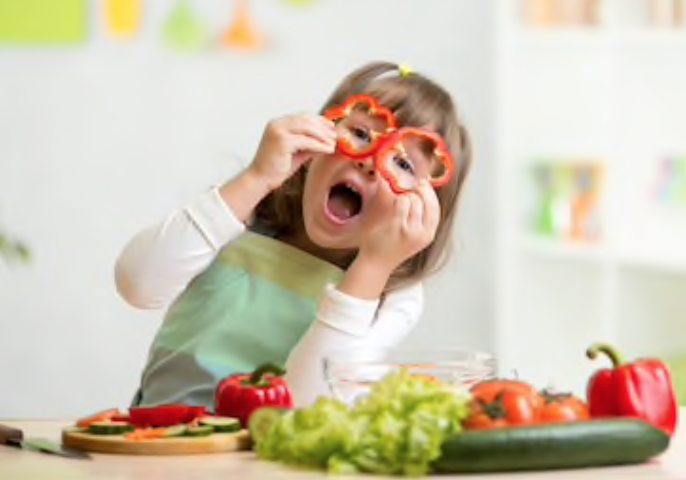
Image from Shutterstock

Eating fruits and veggies first as a strategy to increase fruit and vegetable consumption was tested in a school cafeteria. Elementary school students were given a small serving of vegetables while they waited in line for lunch.4

The result?

Serving vegetables before the lunch meal greatly increased the number of students eating vegetables. In fact, kids consumed 6 times more vegetable servings on days they were offered veggies before lunch!4

Let’s take these findings home!

  1. Enlist helping hands. Get you kids to help out with meal prep. While you’re doing this, serve fruits and veggies as a pre-meal snack.
  2. Make it fancy. Serve fruits and veggies ahead of the meal and give this course a fancy name that kids can get excited about.
  3. Wait for it. Hold off on serving the rest of the meal until at least some fruits and veggies are eaten, but don’t make this a battle. If your child isn’t up for this initially, that’s ok- this may take a couple of tries. 
  4. Eat before you sit. Before your kids even make it to the table, serve them some fruits and veggies.

Image from Shutterstock

You can do this!

Consistency is key for forming habits. Stick with it, regardless of setbacks. Making fruit and vegetable consumption as easy as possible will make for a successful New Year’s resolution!

References

  1. APA report: lack of willpower may be obstacle to improving personal health and finances. American Psychological Association Services, Inc. https://www.apaservices.org/practice/update/2012/02-23/willpower. February 23, 2012. Accessed February 15, 2020.
  2. Norcross JC, Vangarelli DJ. The resolution solution: longitudinal examination of New Year’s change attempts. J Subst Abuse Treat. 1988; 1(2): 127-134. doi: 10.1016/S0899-3289(88)80016-6.
  3. Riis J. The behvavioral science of increasing fruit and vegetable consumption. Have a Plant. https://fruitsandveggies.org/stories/the_behavioral_science_of_increasing_fruit_and_vegetable_consumption/. Published 2020. Accessed February 15, 2020.
  4. Elsbernd SL, Reicks MM, Mann TL, Redden JP, Mykerezi E, Vickers ZM. Serving vegetables first: a strategy to increase vegetable consumption in elementary school cafeterias. Appetite. 96(1); 2016: 111-115. doi: 10.1016/j.appet.2015.09.001.
The best time for new beginnings is NOW!

Fruits and vegetables form the foundation of a healthy, balanced diet. Fruits and veggies provide nutrients that are important for health and the maintenance of a healthy body so you can do the things you love!

Most of us are already well aware of the benefits of eating more fruits and vegetables. Food Cents aims to help you and your family eat more fruits and vegetables by helping you to overcome the barriers that are preventing you from doing so.

Sometimes trying to make a big change, relating to any aspect of our lives, can seem daunting. Let’s face it: Change is tough. But having a plan and an understanding of how behavior change works can help you to feel less overwhelmed. The goal is to help you to make small behavior changes that will eventually add up to big change!

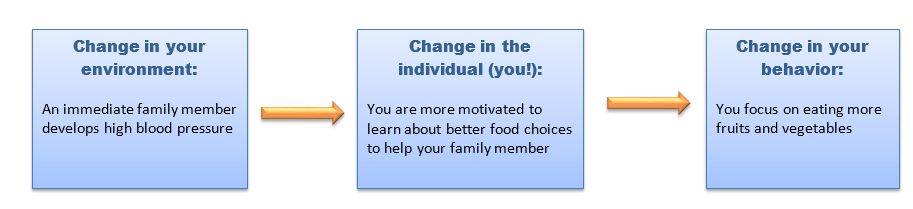
Health professionals often help us to understand change by explaining it using various change theories. An important change theory when it comes to health behavior change is the Social Cognitive Theory, or the SCT for short.1 This theory explains that there is an interaction between personal factors in our lives, our behavior, and the environment. 1 It states that a change in any one of these factors can influence the other factors. 1 The example below helps to explain how the SCT might work in real life. 1

The SCT recognizes that unless you believe in your ability to change a particular behavior, in this case, eating more fruits and vegetables, you will be less able to make the change.2 So believe in yourself and your abilities! Breaking the larger goal into smaller, more manageable goals will help!

Image from Shutterstock

So where do we start?

Let’s start right here, with a smaller, manageable goal: Decreasing the amount of fast food we eat. Research shows that American families eat far too much fast food.3 Eating too much fast food can displace healthier foods in our diets such as fruits and veggies. Let’s take a look at why we eat fast food:

These are all great reasons for eating fast food, but do you know what the even greater thing is? Eating healthier, home cooked meals can be just as convenient, cheap, delicious, and kid-approved! The key is to make the healthy choice, the easy choice. Here are some great strategies for making the healthy choice the easy choice!

Make more than you need. When making soups and stews, make a double portion. You can freeze the leftovers for a quick and convenient weeknight dinner.

Pack a lunch the night before. Dinner leftovers make a great lunch! Don’t wait until the morning to plan what you’re going to eat for lunch that day. Often, time gets the best of us in the morning and having an already packed lunch prevents us from turning to fast food at noon.

Make breakfast easy. Have breakfast foods prepped and ready to go the night before. Cut some fruit or prepare your smoothie. If you eat breakfast, you will be less likely to splurge on fast food later on.

Involve your kids. Make cooking a bonding experience by letting your kids help you in the kitchen. Kids are a great help! This will also teach them about healthy eating and other important life skills.

Put healthy foods in your face. Stock the most accessible shelf in your refrigerator with your favorite fruits and veggies. Have them washed and ready to go so you can grab them at any time.

Try filling clear glass bowls with fresh fruits and place them on your counter. Research shows that women who keep fresh fruit on the counter weigh less than women who don’t.4

Image from Shutterstock

As with any change in our lives, having a strong support system is key! Food Cents aims to build a strong social support system so we can encourage each other to make healthy choices every day. Feel free to share your challenges and successes in the comments- because when one of us succeeds we all do! Don’t forget to check out our Facebook page and Instagram for additional support!

Image from Shutterstock
All it takes it the first step to begin…

“The best time for new beginnings is now.”

Unknown

References

  1. Bauer KD, Liou D. Nutrition Counseling and Education Skill Development. 3rd ed. Boston, MA: Cengage Learning; 2016: 26-29.
  2. Bandura A. Health promotion from the perspective of social cognitive theory. Psychol Health. 1998; 13(4): 623-649. doi: 10.1080/08870449808407422.
  3. Fast food consumption among adults in the United States, 2013-2016. Centers for Disease Control and Protection. https://www.cdc.gov/nchs/products/databriefs/db322.htm. Updated October 30, 2018. Accessed February 2, 2020.
  4. Wansink B. Slim by Design: Mindless Eating Solutions for Everyday Life. New York, NY: Harper Collins Publishers; 2014.
No comments to show.

Why Food Cents?

With food costs on the rise, the dreaded “Mom, what’s for dinner?” question is sometimes a difficult one to answer. We’ve all been there, struggling to decide what to feed our families and ourselves after a tough day at work. This question becomes even harder to answer when your food budget is tight. It feels so much easier and less costly to run out and grab fast food or to toss a frozen pizza into the oven. You’re not alone! Across America there are millions of moms in the same situation. In fact, over 9.5 million families rely on SNAP, or the Supplemental Nutrition Assistance Program, to help put food on the table.1 But the truth is, eating right on a budget does not need to be more challenging or cost more than driving through the nearest drive-thru.

The reality: Poor diet quality is the leading risk factor related to death and disability in the United States- no one is exempt.

The typical American diet is too high in calories, saturated fat, salt, and added sugars and does not include enough fruits and vegetables.2 This diet is a major contributor to many of the leading causes of death in the United States and chronic disease risk including:

  • Heart disease;
  • Diabetes;
  • Stroke;
  • High blood pressure;
  • Obesity;
  • Cancers3

Well over half a million deaths each year in the United States can be attributed to nutrition and obesity related diseases as a result of an unhealthy diet.4 Over the most recent decade, obesity rates in America have continued to rise steadily among adults and youth.5 Sadly, these numbers will continue to grow if immediate action is not taken. There is good news! The first step can begin with you- in your home, on your kitchen table, and in your fridge!

Eating more fruits and veggies can help you live healthier.

Eating the recommended amount of fruits and veggies on a daily basis provides protection against many chronic diseases that are both severe and costly.2 Eating an overall healthy diet that includes a variety of fruits and vegetables helps to combat illness and disease and helps the body to function properly by providing important vitamins and minerals.

We need more fruits and veggies.

Despite the known benefits of eating a diet rich in fruits and veggies, Americans still are not eating anywhere near enough! It is recommended that adults consume 1.5-2 cups of fruits and 2-3 cups of vegetables each day.2 Sadly, fewer than 1 in 10 American adults eat the daily recommended amount of fruits and veggies and this amount is even less for American youth.6

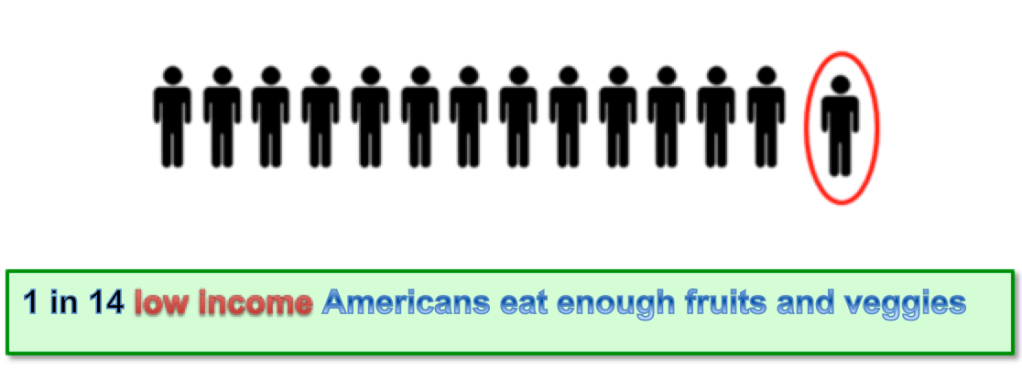
For lower income individuals and families, fruit and vegetable consumption declines even further to about 1 in 14 adults. 6 There is no question- we ALL could benefit from eating more fruits and veggies!

Moms, you can take charge! Food Cents is here to help!

 In America, women make most of the food related decisions for their families. Food Cents aims to encourage and empower moms like you, who are working within a limited food budget, to make healthy food choices for you and your family, with the primary goal of increasing fruit and vegetable consumption. Food Cents will provide tips for planning, budgeting, and creating countless meals and snacks that are cost efficient and delicious. By tapping into the power of produce, Food Cents will make the healthy choice the easiest choice.

References

  1. Understanding SNAP, the Supplemental Nutrition Assistance Program. Feeding America. https://www.feedingamerica.org/take-action/advocate/federal-hunger-relief-programs/snap. Updated January 2020. Accessed January 19, 2020.
  2. U.S. Department of Health and Human Services and U.S. Department of Agriculture. 2015 – 2020 Dietary Guidelines for Americans. 8th Edition. https://health.gov/dietaryguidelines/2015/guidelines/. Published December 2015. Accessed January 19, 2020.
  3. Murphy SL, Xu JQ, Kochanek KD, Arias E. Mortality in the United States, 2017. NCHS Data Brief, no 328. Hyattsville, MD: National Center for Health Statistics; 2018.
  4. The US Burden of Disease Collaborators. The state of US health, 1990-2016: burden of diseases, injuries, and risk factors among US states. JAMA. 2018;319(14):1444–1472. doi:10.1001/jama.2018.0158.
  5. Hales CM, Fryar CD, Carroll MD, Freedman DS, Ogden CL. Trends in obesity and severe obesity prevalence in US youth and adults by sex and age, 2007-2008 to 2015-2016. JAMA. 2018;319(16):1723–1725. doi:10.1001/jama.2018.3060.
  6. Centers for Disease Control and Prevention. 2018 State Indicator Report on Fruits and Vegetables. Atlanta, GA: Centers for Disease Control and Prevention, U.S. Department of Health and Human Services; 2018:4.
  7. Tobey LN, Koenig HF, Brown NA, Manore MM. Reaching low-income mothers to improve family fruit and vegetable intake: Food Hero social marketing campaign-research steps, development and testing. Nutrients. 2016;8(9):562. doi:10.3390/nu8090562.

Design a site like this with WordPress.com
Get started